

Table of Contents
- Quick Comparison: Best Outdoor Fire Table for Coastal Climates
- Why GFRC Fire Table Benefits Matter in Salt Air
- Top Picks: Best Outdoor Fire Table for Coastal Climates
- Choosing the Right Size and BTU Output for Your Patio
- Propane vs. Natural Gas: Fuel for Coastal Homes
- Outdoor Fire Table Maintenance Tips for Salt-Air Environments
- Weatherproof Fire Table Covers and Storage
- Safety Features, Warranty, and What to Expect
- Frequently Asked Questions
Last Updated: September 21, 2026
Quick Comparison: Best Outdoor Fire Table for Coastal Climates
The best outdoor fire table for coastal climates comes down to how well its materials handle salt air. GFRC and powder-coated aluminum resist corrosion and UV damage far better than ordinary concrete or steel.
Here's the short list before the detail:
| Model | Size | BTU | Price | Best For |
|---|---|---|---|---|
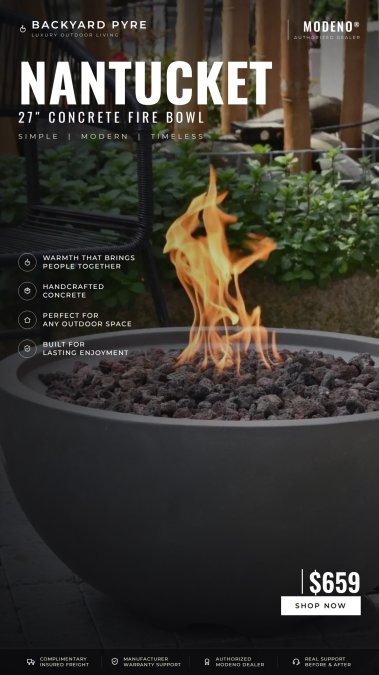
| Nantucket 27" Bowl | 26.4" round | 40,000 | $659 | Small patios, balconies |
| Westport 34" / Roca 34" | 34" | 50,000 | $999 | Four to six seats |
| Columbia 42" / Boulder 43" | 42-43" | 45,000 | $1,359 | Mid-size patios |
| Granville 60" / Hampton 56" | 56-60" | 45,000 | $1,869-$1,879 | Large seating groups |
| Meteor GFRC Table | 55.9" | 60,000 | $2,469 | Contemporary centerpieces |
| Brugge Dining Table | 46.5" square | 60,000 | $2,679 | Outdoor dining |
| Carrara Marble Table | 59.8" | 60,000 | $4,319 | Premium stone look |
Why GFRC Fire Table Benefits Matter in Salt Air
GFRC fire table benefits start with the material. Glass-fiber-reinforced concrete is a cast composite of cement, fine aggregate, and alkali-resistant glass fibers. The fibers carry tensile load, so the shell resists the cracking plain concrete suffers after freeze-thaw and salt exposure.
Corrosion Resistance and Powder-Coated Aluminum
Not every component is concrete. The burner, fasteners, and any structural frame are metal, and metal is where salt air does its damage.
Aluminum vs. Concrete: Which Lasts Near the Ocean?
Powder-coated aluminum is lighter and never rusts through, but it can dent and feels less substantial. GFRC is heavier, holds heat, reads like real stone, and stays planted in coastal wind.
| Factor | GFRC Concrete | Powder-Coated Aluminum |
|---|---|---|
| Salt-air corrosion | High resistance | High resistance |
| Weight | Heavy, wind-stable | Light, easy to move |
| Finish options | Stone, smooth, textured | Matte colors |
| Best placement | Permanent patio | Balcony, deck |
Top Picks: Best Outdoor Fire Table for Coastal Climates
Every model below uses handcrafted GFRC and a stainless burner, the two specs that matter most near the ocean. Sizes run from a 27-inch bowl to a 60-inch dining table.
Compact Coastal Pick: Nantucket 27" Concrete Fire Bowl
The Nantucket is the smallest piece we recommend for salt air, and the one we suggest most for balconies and poolside corners. This Modeno bowl runs a 40,000 BTU stainless burner with a 360-degree flame and weighs just 74 lb.
Mid-Size Value: Columbia 42" and Boulder 43" GFRC Tables
Both tables land at $1,359 and run a 45,000 BTU stainless burner, but they read differently. The Columbia is a clean 42-inch rectangle for modern patios; the Boulder is a 43-inch round with a natural-stone form for landscaped settings.
Large Centerpieces: Granville 60" and Hampton 56"
For a full seating group, the Granville 60" and Hampton 56" are the workhorses. The Granville is a 60-inch rectangle with a 45,000 BTU burner and coffee-table height that seats six to eight, in Light Gray, Dark Gray, and Frosted Cream White.
Premium Stone Look: Carrara and Brugge Marble Porcelain
For the look of natural stone without the upkeep, the marble porcelain tops are the answer. The Carrara pairs a Bianco White marble porcelain top with a 60,000 BTU burner across nearly five feet, and the porcelain shrugs off UV and stains.
Choosing the Right Size and BTU Output for Your Patio
Match the table to your seating group first, then confirm the BTU output fits the space. Too small looks lost; too large crowds the walkway.
Use this rule of thumb:
- Two to four chairs: 27" bowl, 40,000 BTU
- Four to six chairs: 34" to 43", 45,000-50,000 BTU
- Six to eight chairs: 56" to 60", 45,000-60,000 BTU
- Full dining: 46.5" square or larger, 60,000 BTU
Propane vs. Natural Gas: Fuel for Coastal Homes
Propane runs off a standard refillable tank hidden in the base, so you can place the table anywhere on the patio. Natural gas ties into your home's line for unlimited supply and no refills, but needs a fixed hookup at the spot.
Outdoor Fire Table Maintenance Tips for Salt-Air Environments
Outdoor fire table maintenance tips for coastal homes follow one principle: rinse salt off before it bonds. Salt spray leaves a hygroscopic film that pulls moisture from the air and holds it against the surface, driving oxidation on hardware and dulling the finish.
A Salt-Air Maintenance Schedule That Actually Works
Coastal exposure is predictable enough to put on a calendar. A common pattern among owners near the water:
- Every two weeks during beach season (roughly May through September): Rinse the shell and the burner compartment with fresh water. Fresh water dilutes and carries away the chloride film; letting it sit is what causes the bloom.
- Monthly, year-round: Inspect every fastener, the burner tray, and the igniter housing for rust bloom. Rust bloom is the orange surface staining that appears before pitting starts.
- After every rain or heavy spray event: Wipe the burner and igniter dry. Standing water in the ignition path is the most common cause of a no-start.
- Before each season: Clear the burner ports of debris and insect nests. Spider webs and mud dauber nests in the venturi are a leading cause of weak or uneven flame.
- Annually: Reapply a stone sealer if the finish dulls.
Hardware and Fastener Integrity: The Real Failure Point
This is the failure point most buyers miss. The concrete shell will outlast the bolts holding it together, and salt air attacks those bolts first. In a chloride-rich, wet environment, the less noble metal corrodes preferentially, and standard zinc-plated screws are the least noble component in most fire tables, so they go first.
What to look for and what to do:
- 304 stainless steel is the baseline for coastal hardware. It resists chloride pitting far better than zinc-plated or plain carbon steel.
- 316 stainless steel is the marine-grade upgrade. It adds molybdenum, which specifically improves resistance to chloride pitting and crevice corrosion.
- Replace, don't tighten. A rusted bolt that is re-tightened can seize or snap. If you see rust bloom on a fastener, replace it with marine-grade stainless rather than trying to salvage it.
- Check the burner tray fasteners specifically. A loose burner tray is both a safety issue and a warranty headache, and it is the fastener group most likely to loosen from thermal cycling.
Wind-Rated Performance and Wind Guards
Coastal patios get gusts inland patios never see, and wind does two things to a fire table: it pushes the flame off the burner ports, and it increases fuel consumption as the flame fights the draft. A wind guard or wind screen keeps the flame steady and reduces wasted fuel.
If your patio is fully exposed:
- Orient the table so the burner runs parallel to the prevailing wind rather than perpendicular to it.
- Consider a glass wind guard for linear-flame models; a guard that sits close to the burner is more effective than a distant screen.
- A slightly higher BTU rating helps the flame hold its shape in a gust, but it does not replace a guard.
Eco-Friendly Material Longevity: Recycled Plastic Lumber vs. Metal
A question that matters for coastal buyers: how does recycled plastic lumber compare to metal in high-salinity air? It does not corrode, because there is no metal to oxidize, but it does not carry structural load the way a stainless frame does. It suits non-structural trim, spacers, and some furniture frames, while the burner, fasteners, and any load-bearing frame should still be metal.
Weatherproof Fire Table Covers and Storage
A weatherproof fire table cover is the cheapest insurance for a coastal piece. It blocks salt spray, UV, and moisture between uses, slowing oxidation and keeping the finish bright. But the wrong cover can trap moisture against the surface you are trying to protect.
What Makes a Cover Actually Weatherproof
- Material: Look for solution-dyed acrylic or a marine-grade polyester with a waterproof backing. Untreated cotton canvas absorbs water and holds it against the table.
- Fit: A cover should be snug but not airtight. A cover that seals completely traps condensation underneath, and condensation is as damaging as rain.
- Ventilation: The best covers have vents or a breathable panel. Ventilation lets moisture escape while still shedding rain and spray.
- Fastening: Drawstrings, buckles, or weighted hems keep the cover from lifting in coastal wind. A cover that flaps in a gust abrades the finish it is supposed to protect.
Every model in this guide ships with a cover. If you replace one, match the material and ventilation spec rather than buying the cheapest generic option.
Off-Season and Storm Storage
If not, keep the cover on and check the burner compartment after storms. Two coastal habits matter:
- After a storm, remove the cover and let the burner compartment air out. A cover that sat through a storm can hold a pocket of moisture against the burner and igniter.
- Before a long off-season, disconnect the fuel supply and store the burner components dry. For propane, that means shutting off the tank and disconnecting the hose; for natural gas, it means shutting off the supply valve at the source.
A Note on Placement
Where the table sits matters as much as how you cover it. If you have a choice, place it on the leeward side of the patio and away from the splash zone of a pool or spa. That single decision reduces the maintenance load more than any accessory.
Safety Features, Warranty, and What to Expect
Safety and warranty are where coastal buyers should read the fine print. Every model here uses a stainless burner and an ignition system with a safety shut-off or push-button control, and all are rated for propane or natural gas.
Frequently Asked Questions
What materials are best for outdoor furniture in coastal climates?
GFRC (glass-fiber-reinforced concrete) and powder-coated aluminum are top choices for coastal fire tables. GFRC resists moisture and salt air, while powder-coated aluminum avoids rust. Stainless steel burners, like the 304-grade in Elementi and Modeno models, handle humidity well. Avoid untreated steel or low-grade concrete that can crack or corrode. A coastal fire table built from these materials will last far longer with proper care.
Do concrete fire tables hold up near the ocean?
Yes, if they are made from GFRC. Handcrafted GFRC is dense and weather-resistant, unlike standard concrete that can absorb salt and moisture. Models like the Meteor and Columbia are built to live outside year-round. Regular cleaning and a weatherproof cover extend life. Check hardware and fasteners annually for corrosion. With basic maintenance, a GFRC coastal fire table can last many seasons.
How do I protect my outdoor fire table from salt air corrosion?
Rinse the tabletop and burner area with fresh water monthly, then dry thoroughly. Use a weatherproof fire table cover when not in use. Inspect fasteners and the ignition system for oxidation. For propane models, store the tank in a dry, ventilated spot. These steps slow salt-air damage and keep your coastal fire table looking new.
Is aluminum or steel better for a fire table in a humid environment?
Powder-coated aluminum resists rust better than steel in humid, salt-air conditions. Steel, especially stainless steel, is used for burners because it handles high heat. For frames and hardware, aluminum is often preferred. Check that any steel components are 304 stainless. A coastal fire table with aluminum framing and stainless burners offers the best balance of durability and performance.
How often should I clean my fire table if I live near the beach?
Clean your fire table at least once a month, or more often if you notice salt residue. Wipe the surface with a damp cloth and mild soap, then rinse with fresh water. Check the burner ports for debris. After storms, inspect immediately. A consistent maintenance routine prevents oxidation and keeps the ignition system working. Always dry the table before covering it to avoid trapped moisture.
A coastal patio is a real investment, and salt air punishes the wrong materials fast. The fix is choosing handcrafted GFRC with a stainless burner and keeping up a simple rinse-and-cover routine. Luxury outdoor fire features carries a curated range of Elementi and Modeno fire tables and bowls, backed by authorized dealer status, complimentary shipping, and genuine manufacturer warranties. Get started with Luxury outdoor fire features and find the fire table built to hold up on your coast.