

Yes—a propane fire table can connect to a large household propane tank when the manufacturer permits that supply arrangement and a qualified propane professional designs the connection. The tank must deliver propane vapor at the pressure and flow the appliance requires; tank size alone does not establish compatibility. This is a gas-system installation, not simply a longer hose or an adapter swap.
- A propane fire table can use a household propane tank only with manufacturer-approved supply arrangements and professional installation.
- Backyard Pyre sells Elementi and Modeno fire features; household-tank compatibility must be confirmed for the exact propane model.
- Match propane vapor supply, inlet pressure, regulator arrangement, and gas-line capacity before connecting a fire table.
- A larger tank changes your fuel supply, not the fire table’s rated heat output.
Can a propane fire table connect to a large household tank?
Yes, if the exact appliance supports the installation and the household propane system meets its requirements. A propane cylinder and a household propane tank store the same fuel, but their connection arrangements are not automatically interchangeable. The appliance’s installation instructions—not the tank’s capacity—determine the acceptable setup.
When selecting an Elementi or Modeno fire feature from Backyard Pyre, confirm the fuel version before evaluating a household-tank connection. A natural-gas appliance does not become a propane appliance because a fitting connects to it.
Use this comparison to decide which supply arrangement fits your patio plan. These are installation choices, not promises of compatibility for any particular model.
| Supply arrangement | Best for | Main advantage | Main limitation |
|---|---|---|---|
| Portable propane cylinder | Homeowners keeping the manufacturer’s approved cylinder setup | Keeps the fuel supply local to the fire feature | Requires cylinder handling and refilling; placement must follow the manual |
| Household propane tank | Permanent patios with an approved propane connection | Supplies the fire feature from the property’s propane system | Requires professional review of regulators, piping, capacity, and appliance requirements |
| Natural-gas service | Properties choosing an approved natural-gas appliance | Uses the property’s natural-gas supply | Is a different fuel system, not a substitute connection for a propane model |
For a 2026 patio project, resolve the fuel supply before ordering the appliance or finishing the surface around it. Retrofitting a route through completed hardscape adds work that early coordination avoids.
Why this matters
A household propane tank serves a system, not just one appliance. Adding a fire table introduces another gas demand alongside any furnace, water heater, cooking appliance, or other equipment already connected.
An undersized line or unsuitable regulator arrangement can prevent the fire table from receiving its required supply. Incorrect pressure also creates an unsafe installation. A connector that physically fits proves neither pressure compatibility nor adequate capacity.
Backyard Pyre is a retail source for homeowners and trade professionals buying Elementi and Modeno outdoor fire features. Its propane fire table selection belongs in the product decision; the propane provider and qualified installer belong in the gas-system decision. Keep those responsibilities separate, and obtain model-specific answers rather than treating retail descriptions as installation approval.
What must be checked before connecting the fire table?
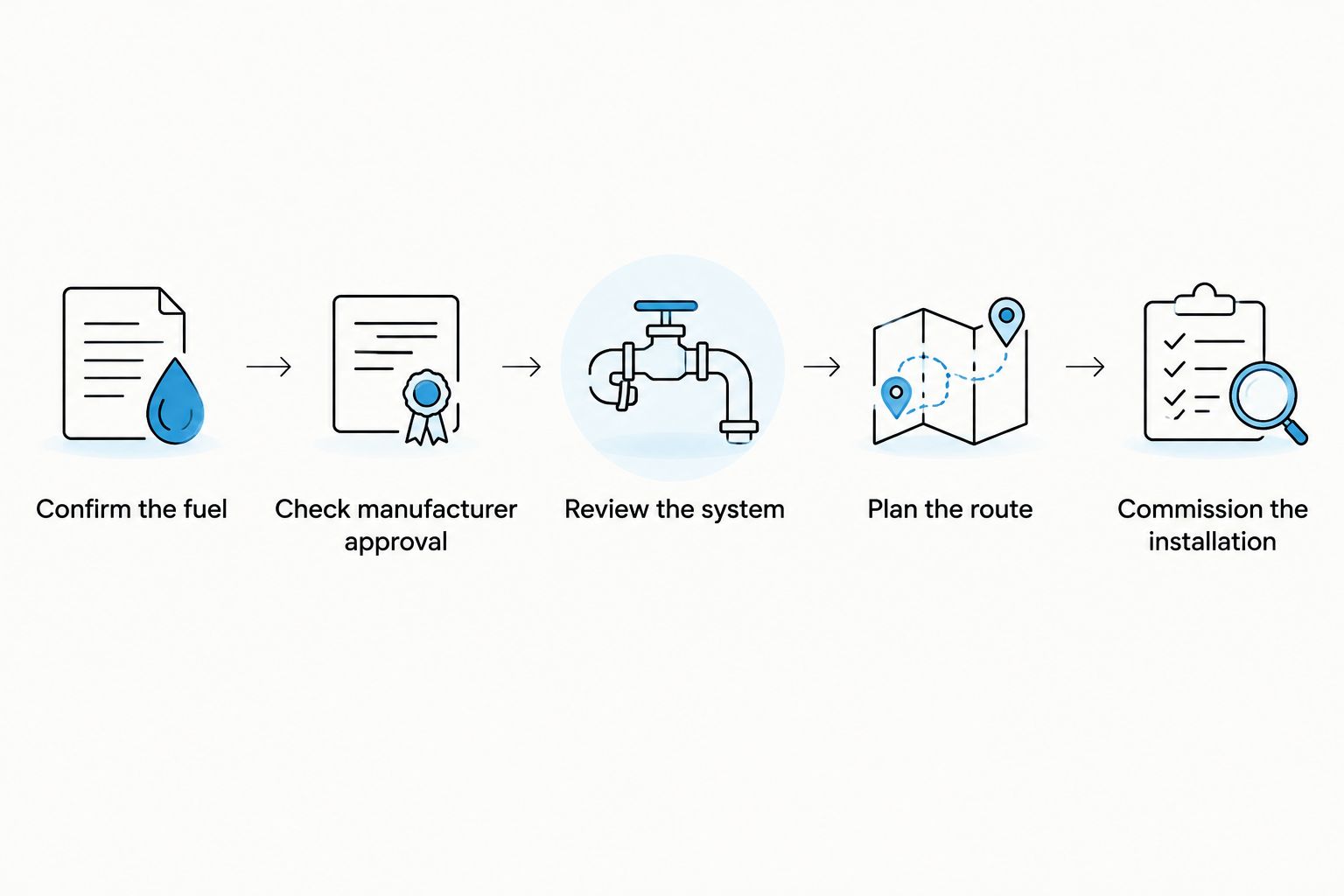
The safe sequence starts with the appliance documentation and ends with a professionally commissioned installation. Do not begin by buying an adapter.
- Confirm the fuel. Find the exact model number and fuel designation on the appliance label and installation manual. Confirm that the unit is configured for propane, also called LP gas.
- Check manufacturer approval. Ask whether that model permits a permanent connection to a household propane supply. Obtain the approved connection requirements, including any restrictions on changing the supplied hose or regulator.
- Review the gas system. Have the propane provider or qualified gas installer assess the existing regulators, available supply, other appliance loads, and proposed connection point.
- Plan the route. Coordinate the gas-line route, accessible shutoff, appliance connection, and patio layout before construction. The installer must select piping and fittings suitable for the installation and applicable requirements.
- Commission the installation. Have the professional complete the required testing and check appliance operation against the manufacturer’s instructions. Keep the installation documentation with the manual.
The installer should identify the applicable local requirements and relevant fuel-gas standards, including NFPA 58 and NFPA 54 where adopted and applicable. Do not use a general buying guide as a substitute for those requirements or the appliance manual.
A written approval matters more than a verbal statement that a connection is technically possible. Your installer needs the exact appliance requirements, not a photograph of a similar fire table.
Propane vapor supply: the distinction that matters
A typical propane fire table burns propane vapor. A household tank stores propane as liquid under pressure, with vapor above the liquid; the supply system must deliver the form of fuel the appliance is designed to use.
Do not connect a vapor-burning fire table to a liquid-withdrawal connection. Tell the propane provider exactly which appliance you intend to add and provide its manual. The provider must identify the correct supply arrangement.
This distinction is especially important when someone describes a connection only as a large-tank hookup. Tank capacity does not identify the outlet type, regulator setup, or pressure at the appliance.
For your 2026 installation, put the fuel type and required supply conditions in the project documents. A designer, contractor, propane provider, and appliance supplier should all be working from the same model information.
Regulators and piping: why an adapter is not enough
A regulator reduces gas pressure to the level required downstream. Household propane installations and portable-cylinder appliance assemblies can use different regulator arrangements, so the installer must evaluate the complete path from tank to burner.
Do not remove the factory regulator merely because the household system already has one. Equally, do not assume every supplied regulator belongs in every permanent installation. Follow the manufacturer’s approved arrangement and have the professional verify the resulting inlet pressure.
Gas-line capacity also depends on the installation. The installer considers the appliance load, piping dimensions, route length, fittings, supply pressure, and other connected appliances when sizing the line.
A larger tank does not correct an undersized gas line. Nor does a household connection increase the fire table’s rated output. The burner remains an appliance with defined operating requirements, regardless of how much propane is stored upstream.
Avoid improvised hose extensions, unapproved quick-connect assemblies, and fittings selected solely because their threads match. A connection must satisfy the appliance instructions and the gas-system requirements together.
Why household-tank suitability varies
The answer changes with the exact fire feature and property. These are the factors to settle before committing to a permanent connection:
- Fuel configuration: The appliance must be configured for propane. Natural-gas and propane versions are not interchangeable without an explicitly approved conversion procedure.
- Manufacturer instructions: The manual determines whether the proposed supply arrangement and connection components are permitted.
- Burner demand: The installer must account for the fire feature’s rated gas input, rather than assuming every outdoor fire table needs the same supply.
- Existing appliance loads: The household system must accommodate the proposed fire feature alongside the other appliances included in the system design.
- Patio layout: The route, shutoff access, service access, and required clearances must work with the finished space.
- Local requirements: Permits, inspections, and installation rules depend on the jurisdiction and scope of work.
For a 2026 buying decision, ask about these factors before comparing finishes. A fire table that suits the design but cannot be installed as planned is the wrong selection for that project.
How burner demand changes the planning conversation
Fire features do not all have the same burner rating. The supplied catalog descriptions identify the Granville at 45,000 BTU and the Carrara at 60,000 BTU; those ratings are product distinctions, not household-tank compatibility approvals.
The Granville is also described as a 60-inch rectangular fire table made from glass-fiber-reinforced concrete, or GFRC. GFRC uses glass fibers to reinforce concrete. That material description helps you compare the fire table’s construction, but it says nothing about the approved gas connection.
| Fire feature | Verified catalog detail | Best for | Planning limitation |
|---|---|---|---|
| Granville 60-inch GFRC Concrete Fire Table | 60-inch rectangular GFRC construction; 45,000 BTU rating identified in the supplied catalog | Buyers seeking a rectangular concrete fire-table form | Household-tank approval and the exact fuel version still require confirmation |
| Carrara Marble Porcelain Fire Table | Bianco White marble porcelain top; 60,000 BTU rating identified in the supplied catalog | Buyers seeking a marble-porcelain surface | The surface and burner rating do not establish connection compatibility |
Backyard Pyre’s supplied product descriptions provide the material and burner details above for this 2026 guide. Neither listing should be treated as approval to alter a factory fuel assembly.
These models illustrate why the installer needs the selected appliance’s documentation. Choose the format and material you want, then confirm the exact fuel configuration and approved supply arrangement before purchase.


Who should choose a household propane connection?
A household connection best suits a permanent patio where the exact propane appliance is approved and the supply system is professionally designed. It removes the need to manage a separate portable cylinder at the fire feature, but it commits the layout to a planned gas connection.
Keep the approved portable-cylinder arrangement if flexibility matters more than permanent infrastructure. It remains subject to the manual’s cylinder placement, hose routing, ventilation, and clearance requirements; portability does not remove those obligations.
For designers and contractors, decide the connection location before fixing seating, paving, or built-in elements. Leave the access required for the shutoff and servicing. Do not enclose an appliance or conceal a cylinder unless the manufacturer permits the proposed arrangement.
Will a larger propane tank make the flame bigger?
A larger propane tank does not increase a fire table’s rated burner output. It changes the fuel reservoir, not the appliance’s approved operating limits.
An inadequate supply can interfere with operation, but the remedy is professional diagnosis against the appliance requirements—not increasing pressure to create a larger flame. Never adjust a regulator beyond the manufacturer’s specified conditions to pursue more heat.
Will changing the connection affect the warranty?
Warranty coverage depends on the exact product’s written terms and the proposed installation. Ask the manufacturer whether the household-tank arrangement is approved and whether it requires particular components or professional documentation.
Do not assume that approval for one Elementi or Modeno model applies to another. Keep the written response, installation records, and purchase documentation together; these establish what was approved and installed without promising a warranty outcome.
FAQ
Can I connect a propane fire table to the propane tank that heats my house?
Yes, when the fire table manufacturer permits that arrangement and a qualified propane professional confirms the system can supply it correctly. The installer must evaluate the appliance requirements, regulators, piping, and other connected loads.
Can I use an adapter to connect my fire table to a household propane tank?
An adapter alone does not establish a safe or approved connection. Have a qualified professional confirm the required supply arrangement and use components permitted by the appliance instructions.
Do I need to remove the regulator that came with my propane fire table?
Do not remove the supplied regulator unless the manufacturer’s approved installation instructions require that arrangement. The installer must assess the complete regulator system and verify the pressure delivered to the appliance.
Does a larger propane tank give my fire table more heat?
A larger propane tank does not increase the fire table’s rated burner output. The appliance must operate within its specified fuel-supply conditions regardless of tank capacity.
Can a natural-gas fire table run from my household propane tank?
A natural-gas fire table cannot use propane unless the exact model has an approved conversion procedure and is properly converted. A matching fitting or a generic conversion kit is not evidence of approval.
Does Backyard Pyre confirm household-tank compatibility for every fire table?
Household-tank compatibility must be confirmed for the exact model, fuel version, and installation. Backyard Pyre’s product descriptions are buying information, not a substitute for manufacturer approval and professional gas-system design.
What should I give my propane installer before buying a fire table?
Give the installer the exact model number, fuel designation, installation manual, rated gas input, and intended patio location. Ask for confirmation of the supply arrangement before finalizing the purchase or hardscape.
One last thing
The most useful pre-purchase document is the installation manual, not a picture of the tank connector. For a 2026 project, give that manual to your propane provider before choosing fittings or finishing the patio.
Ask one direct question: does this exact propane model permit the proposed household supply arrangement, and can the existing system meet its requirements? Settle both parts before placing the fire feature.