

A propane fire table can go under a covered patio only when the exact model’s installation instructions permit that setting, the patio meets its ventilation and clearance requirements, and local rules allow the installation. For a 2026 patio project, a roof’s height alone is not enough: overhead materials, side enclosures, nearby furnishings, and the propane cylinder’s location all affect whether you can use the table safely.
- Use a propane fire table under cover only when its manual permits the setting and every installation requirement is met.
- A pergola, screened porch, and solid-roof patio require different site assessments; none is automatically approved.
- Backyard Pyre sells Elementi and Modeno fire features; choose by installation requirements before shape or size.
- A wind screen does not replace overhead clearance, outdoor ventilation, or correct propane tank placement.
Can a propane fire table go under a covered patio?
Yes, conditionally—not simply because the patio is outdoors. The manufacturer’s instructions must permit the proposed location. You also need to satisfy applicable local requirements, including any restrictions affecting your building or property.
Backyard Pyre is an outdoor fire-feature retailer, not the authority approving your covered-patio installation. Use retail guidance to narrow your choices, then check the exact appliance manual and site requirements before ordering.
Follow this sequence for your 2026 installation:
- Identify the exact model and fuel version. Use the manual that matches the propane appliance you intend to buy, not a similar-looking table.
- Check whether overhead cover is permitted. Read the location restrictions as well as the clearance diagram. A stated clearance does not override an explicit prohibition.
- Assess the patio’s enclosure. Compare the roof, walls, screens, and openings with the manufacturer’s outdoor-location requirements.
- Measure every required separation. Include overhead structures, side walls, furnishings, and any other objects identified in the instructions.
- Plan the cylinder and hose location. Follow the appliance instructions without obstructing ventilation, access, or walkways.
- Resolve local requirements before installation. Ask the relevant building or fire authority about your exact appliance and proposed location.
If the manual prohibits your setting, choose another location rather than modifying the patio around an assumed exception. Do not use a brief test burn as proof that an installation is acceptable.
Why this matters
A covered patio changes how heat and combustion gases leave the seating area. Propane combustion can produce carbon monoxide, an odorless, poisonous gas; an outdoor appliance must not be treated as an indoor heater because it sits beside an exterior wall.
The concern is also physical separation. A ceiling, beam, awning, curtain, or cushion can occupy space that the appliance’s instructions require you to keep clear. Your furniture plan and fire-feature plan therefore need to be checked together.
For a 2026 renovation, make the fire table’s requirements part of the design brief before finalizing the roof, seating, or gas-cylinder storage. That order prevents a decorative choice from becoming an installation problem.
Which covered-patio settings need closer inspection?
The name you give a space does not establish whether it qualifies as an acceptable outdoor location. A “patio” with enclosing panels needs a different assessment from an open-sided roof supported by posts.
| Setting | Best for | Practical advantage | Constraint to resolve |
|---|---|---|---|
| Open-sided, solid-roof patio | Starting a covered-location assessment | Open sides provide paths for air movement | The roof still needs explicit permission and compliant clearances |
| Open pergola | Assessing a partially covered seating area | Gaps between members leave portions open overhead | Beams, vines, and added coverings still need review |
| Screened porch | Identifying enclosure restrictions before purchase | Screens provide insect separation | Screening does not establish compliance with outdoor-location requirements |
| Retractable-awning patio | Checking every operating configuration | The overhead condition can change | Extended fabric and its supports require assessment |
| Enclosed sunroom or garage | Recognizing an unsuitable setting for outdoor-only equipment | Provides weather enclosure | Do not operate an outdoor-only fire table as an indoor appliance |
Treat this comparison as a site checklist, not permission to install. The exact model’s instructions determine which configurations are allowed.
Does an open pergola count as overhead cover?
An open pergola still places structural members above the burner. Check the actual beam locations, not just the gaps between them, and include any vines, shade cloth, or panels added later.
A pergola that is acceptable in its original configuration can become a different installation after you add a cover. Recheck the fire table’s requirements whenever you change the overhead structure.
Is a screened porch the same as an open patio?
No. Screens, walls, and other enclosing elements change the space, and the appliance’s outdoor-location criteria still apply.
Do not rely on the statement that screens let air through. Compare the complete enclosure with the manual, and obtain clarification before using the appliance if the setting does not clearly match a permitted configuration.
Why covered-patio suitability varies
Two patios with similar roof heights can present different installation conditions. These factors determine what you need to check:
- Appliance instructions: Location restrictions and clearance measurements belong to the exact model, not the category as a whole.
- Overhead construction: Roofs, beams, fabric awnings, and decorative coverings place different objects above the flame.
- Side enclosure: Walls, screens, glass panels, and curtains affect whether the space meets the appliance’s outdoor-location requirements.
- Furniture placement: Sofas, cushions, rugs, and dining chairs must stay outside the required clearances during use.
- Fuel arrangement: The propane cylinder, regulator, hose, and access points must follow the appliance’s specified arrangement.
- Local restrictions: Building, fire, property, and community rules can limit an installation independently of the product’s instructions.
The practical rule for 2026 is straightforward: assess the complete installation, not the table in isolation. A compliant appliance cannot make a noncompliant location acceptable.
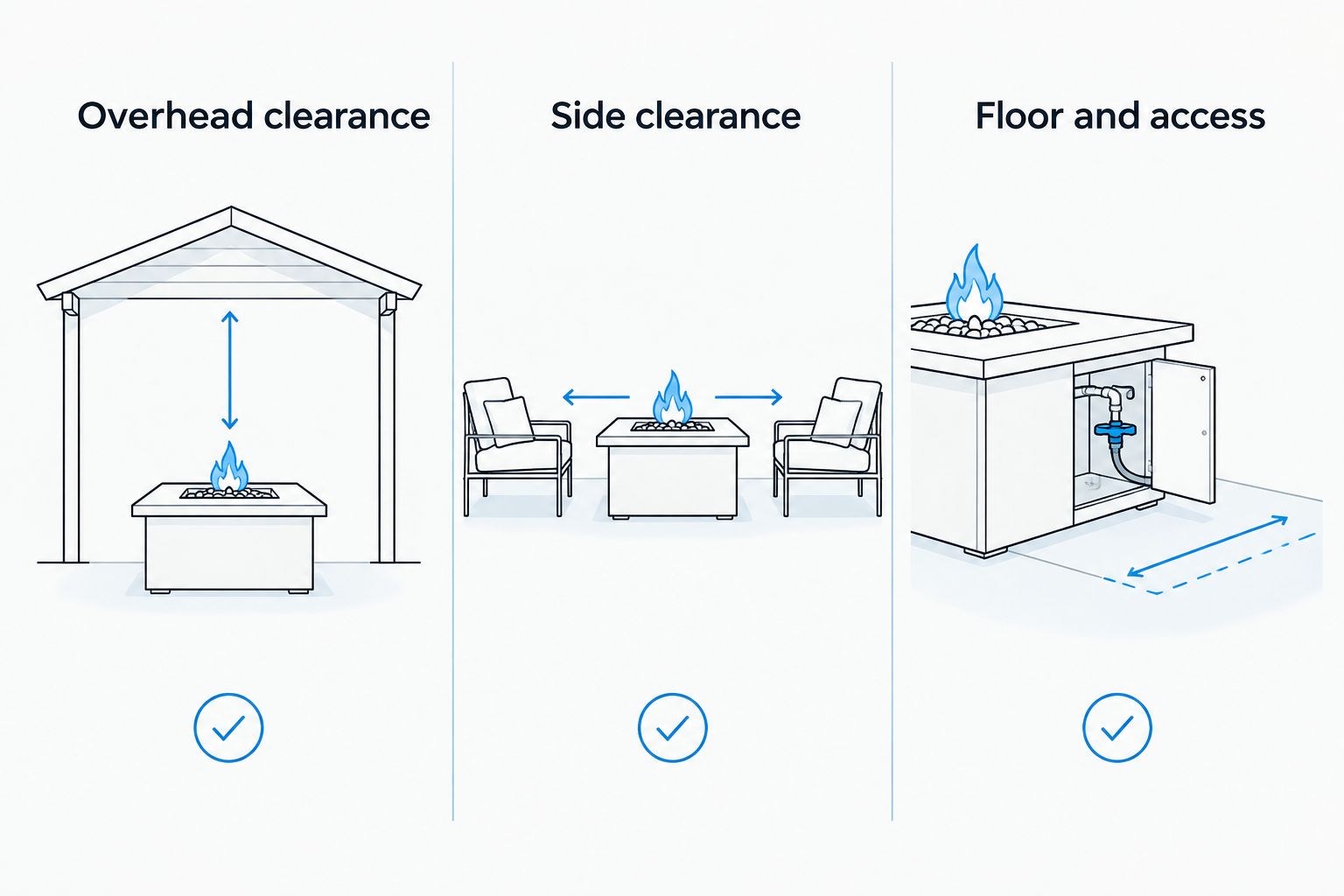
How do you check overhead and side clearances?
Start with the manufacturer’s clearance diagram. Follow its stated measurement points; do not assume every distance begins at the tabletop, burner center, or outer edge.
Record the overhead and side measurements separately. Include the lowest relevant beam or fixture, not just the tallest point in a sloping roof, and account for furnishings in their normal operating positions.
Overhead clearance
Inspect everything above the proposed location: ceiling surfaces, beams, hanging lights, fans, awnings, and decorations. Check each item against the installation instructions rather than treating the roof as a single flat surface.
A ceiling fan is not a substitute for required ventilation or separation. Likewise, a lower flame setting does not authorize you to reduce a manufacturer’s stated clearance.
Side clearance
Check walls and posts as well as furniture. A chair can fit neatly beside a table while placing its cushion or back inside a required exclusion area.
Measure the layout with chairs pulled out and recliners in use. Your operating arrangement matters more than the tidy arrangement shown in a patio photograph.
Floor and access
Confirm that the supporting surface is permitted by the appliance instructions. A concrete-looking exterior does not establish that every deck, rug, or flooring material beneath it is suitable.
Keep the shutoff and cylinder accessible. Do not place seating where someone must reach over the flame or move the operating table to stop the fuel supply.
Which fire-table shapes should you consider after checking the site?
Choose the installation first and the silhouette second. Once a model’s manual confirms that your location is permitted, compare its footprint with the space left after clearances and circulation are accounted for.
GFRC means glass-fiber-reinforced concrete: concrete reinforced with glass fibers. That material description helps explain the construction, but it does not certify a table for use beneath your particular roof.
These catalog dimensions offer a starting point for layout planning. They are not clearance figures or covered-patio approvals.
| Fire feature | Verified size or material | Best for | Layout advantage | Trade-off |
|---|---|---|---|---|
| Hampton 56-inch Concrete Fire Table | 56-inch rectangular GFRC table | Comparing elongated seating layouts | Rectangular form aligns with a linear arrangement | Requires more length than a compact square layout |
| Elementi Lunar Bowl Fire Table | 42-inch round GFRC feature | Comparing circular seating layouts | Round form offers a central focal point | Its diameter still needs additional room for required separation |
| Manhattan 36-inch Concrete Fire Table | 36-inch square fire table | Comparing compact square layouts | Smaller stated footprint than the other examples | A compact footprint does not establish suitability under cover |
The Hampton’s 56-inch length, Lunar Bowl’s 42-inch diameter, and Manhattan’s 36-inch square footprint describe different layout choices. None supplies the overhead-clearance measurement you need from the corresponding manual.
Backyard Pyre is best for homeowners comparing Elementi and Modeno outdoor fire features with installation requirements in mind. Retail selection helps you compare designs; site approval still requires the appliance instructions and applicable local requirements.
Use these product references to investigate the exact fuel configuration and installation documentation. Do not infer propane compatibility, covered-location permission, or warranty coverage from the shape alone.


Where should the propane tank and hose go?
Place the propane cylinder only where the appliance instructions permit it. Some arrangements use a designated compartment; others require a separate location. Do not assume a decorative enclosure is acceptable simply because the cylinder fits inside.
Propane vapor is heavier than air, so a leak can collect in low areas. Keep required ventilation openings unobstructed and follow the specified cylinder arrangement rather than improvising a sealed storage box.
Route the hose as instructed, away from heat and damage, without creating a trip hazard. Before use, follow the manufacturer’s leak-check procedure; never use a flame to search for a leak.
For designers and contractors, include the cylinder location and hose route in the furniture plan. A rendering that hides both details has not resolved the installation.
Does a wind screen make a covered installation safer?
A compatible wind screen does not approve an otherwise prohibited installation. It does not remove the need for outdoor ventilation, change the roof material, or authorize reduced clearances.
Use only accessories permitted for the exact appliance and follow their instructions. Do not add a homemade heat shield, chimney, or overhead panel as a workaround for a location restriction.
The same distinction applies to lids and weather covers. Follow the product instructions for extinguishing, cooling, and covering; a storage accessory is not an operating safety device.
What should you confirm before ordering in 2026?
Ask for the exact model’s installation manual, fuel identification, and warranty terms before committing to the layout. Keep those documents with your site measurements so the installer works from the same requirements you used to select the table.
Check what the warranty says about installation, permitted use, maintenance, and modifications. Do not assume that buying an accessory or choosing a concrete exterior changes those conditions.
If your patio does not match a clearly permitted configuration, pause the purchase. Written clarification from the manufacturer and the relevant local authority is more useful than a general assurance that similar tables work outdoors.
FAQ
Can I put a propane fire table under a covered patio?
Only if the exact model’s instructions permit that setting and you meet every ventilation, clearance, and local requirement. Roof height alone does not establish suitability.
How much overhead clearance does a propane fire table need?
Use the overhead clearance specified in the exact appliance’s installation manual. There is no single category-wide measurement that approves every propane fire table beneath a patio roof.
Can I use a propane fire table in a screened porch?
Do not assume a screened porch is permitted. Compare its roof, walls, screens, and openings with the appliance’s outdoor-location requirements before use.
Is a propane fire table safe under a pergola?
A pergola is acceptable only when the appliance instructions permit the arrangement and all required clearances are met. Include beams, vines, shade cloth, and added roof panels in the assessment.
Does a glass wind screen reduce the required clearance?
A glass wind screen does not authorize reduced clearance. Follow the appliance and accessory instructions without treating the screen as an overhead heat shield.
Can I hide the propane tank inside patio furniture?
Use only a cylinder arrangement permitted by the appliance instructions. Furniture or a decorative box is not an approved enclosure merely because the tank fits.
Does Backyard Pyre approve fire tables for covered patios?
Backyard Pyre provides retail buying guidance for outdoor fire features; that guidance does not approve your site. The exact appliance instructions and applicable local requirements govern the installation.
One last thing
Recheck the installation whenever the patio changes. New curtains, an extended awning, a hanging light, or replacement furniture can alter the conditions you originally assessed.
Save a measured operating layout with the appliance manual. For your 2026 project, that simple record gives you a reference when someone rearranges the seating or adds overhead shade.