

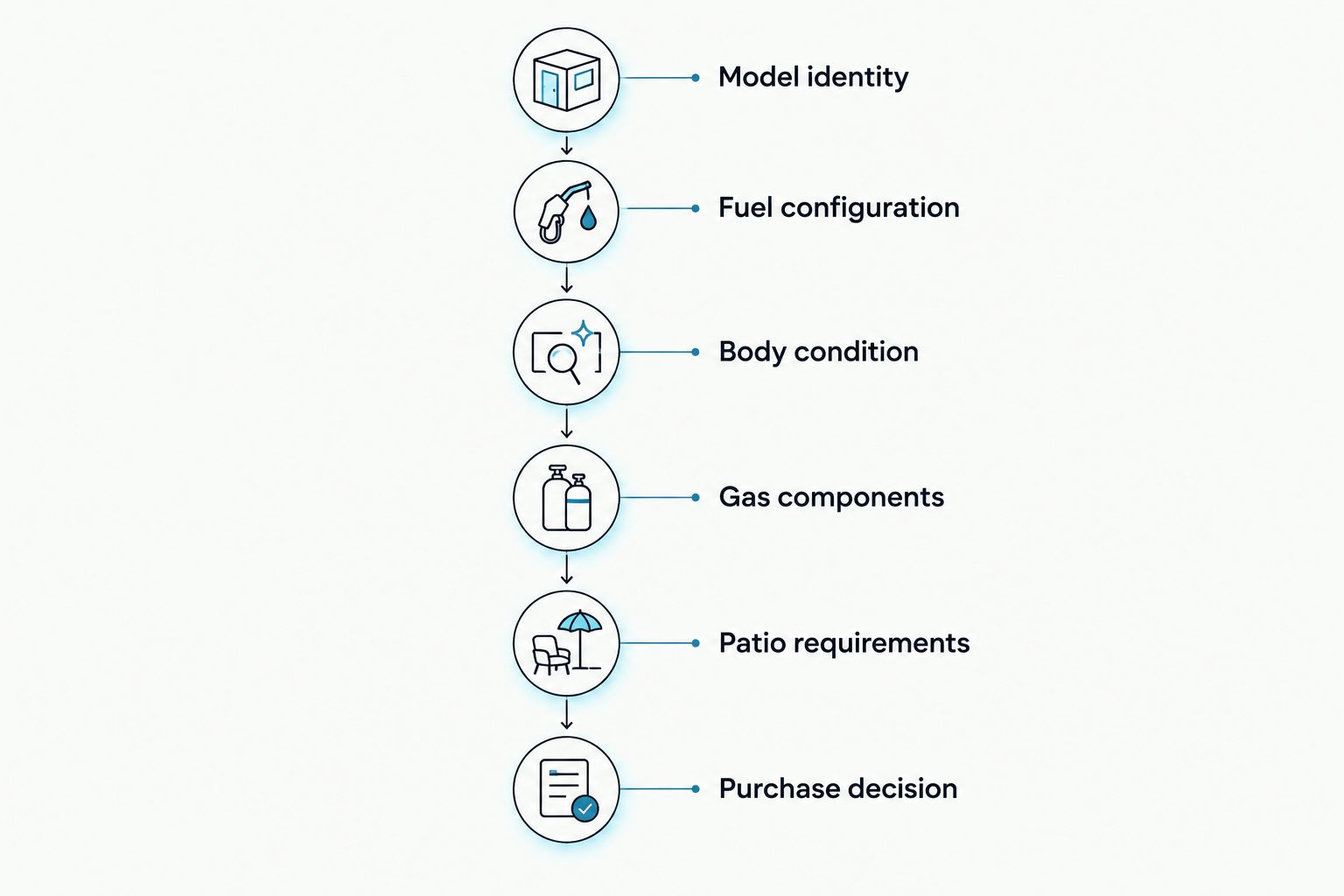
Before buying a used propane fire table, verify its model and propane rating, inspect the body and gas components, and have a qualified gas technician assess any damage, alterations, or uncertain operating condition. Match the table to its original manual and your planned patio location before agreeing to buy. Reject a table with an unidentified fuel setup, unresolved gas leaks, or structural damage; a successful ignition does not establish safety.
- Buy a used propane fire table only after verifying its identity, fuel system, condition, and installation requirements.
- Backyardpyre offers Elementi and Modeno fire features; compare documented specifications before evaluating a secondhand listing.
- A working flame does not prove that hoses, regulators, safety controls, or the installation are safe.
- Missing labels, undocumented conversions, and unresolved leaks are reasons to stop the purchase.
Why this matters
A used fire table combines outdoor furniture with a gas appliance. The surface finish tells you little about the condition of the hose, regulator, burner, or controls. Treat the furniture inspection and the gas-system inspection as separate decisions.
For your 2026 purchase, start with the exact model rather than the seller's description. Backyardpyre sells Elementi and Modeno outdoor fire features, but a brand name alone does not identify the fuel configuration, required accessories, or installation instructions of a secondhand unit.
The advantage of buying used is the opportunity to reuse a suitable appliance. The drawback is an uncertain ownership, maintenance, and modification history. Buy the documented appliance, not the reassuring story.
What should you check before buying a used propane fire table?
Follow these checks in order. Establish identity and condition before anyone attempts to light the appliance.
1. Read the rating plate and identify the exact model
Ask for clear photographs of the rating plate, model number, serial number, burner area, controls, underside, and gas connections. A photograph of the table from across the patio is not enough. You need to connect the actual appliance to the correct manufacturer's instructions.
Read the fuel designation on the appliance. Propane and natural gas require different gas-system configurations; a seller calling the table a propane model does not establish that its present components are correct.
Stop if the label is missing or unreadable until the manufacturer or a qualified technician can establish the appliance's identity. Without that identification, you cannot reliably check installation requirements, replacement parts, or recall information.
2. Obtain the manual and ask about alterations
Get the manual for the exact model and fuel version. Compare its component descriptions and illustrations with the table in front of you. An instruction booklet from a visually similar table is not a substitute.
Ask whether the owner changed the burner, regulator, hose, valve, ignition assembly, or fuel type. Request documentation for any work, including the parts used. An undocumented conversion is a reason to pause the purchase, not an invitation to reconnect a cylinder and experiment.
For a 2026 listing, also check the manufacturer's recall notices and the U.S. Consumer Product Safety Commission's recall database using the model information. Establish whether any applicable corrective action has been completed before buying.
3. Inspect the body, base, and burner support
Inspect the table cold, with the fuel supply shut off. Look underneath and behind access panels where the manual permits access. Check for broken supports, unstable feet, damaged access doors, and deterioration around the burner opening.
GFRC means glass-fiber-reinforced concrete: concrete reinforced with glass fibers. Do not treat every mark on a GFRC surface as proof of structural failure, but do not dismiss cracks, loose pieces, or a distorted burner support as cosmetic without assessment.
Ask the seller about drops, impacts, repairs, and exposure to standing water. A patched finish can conceal the location of earlier damage. If you cannot determine whether the burner and gas components remain properly supported, stop the inspection and seek qualified assessment.
4. Inspect the gas path without modifying it
Look for cracked or abraded hose surfaces, crushed sections, corrosion, damaged fittings, and evidence of improvised connections. Check the regulator and hose against the parts specified for the exact model. Similar-looking components are not proof of compatibility.
Do not disassemble gas fittings, substitute a regulator, or bypass a control to make the table run. Have a qualified gas technician evaluate questionable components and perform the appropriate leak and operating checks.
Never use a flame to check for a gas leak. If you smell gas, do not attempt ignition; move away and follow the propane supplier's emergency guidance. A purchase inspection is not the place to troubleshoot an active leak.
5. Assess the burner and controls before a demonstration
Inspect the cold burner area for debris, corrosion, loose components, and incorrectly placed fire media. Compare the media type and placement with the manual. Do not assume decorative stones or glass supplied by the seller are approved for that burner.
A competent operating demonstration follows the manufacturer's lighting procedure, after the appliance's condition and connections have been checked. Observe whether ignition and shutdown work as directed. Persistent ignition failures, unusual combustion, soot, or a flame that repeatedly goes out require diagnosis rather than reassurance.
Do not accept a bypassed safety device or a seller's improvised lighting method as normal operation. A table that needs a workaround is not ready to buy for immediate use.
6. Inspect the cylinder and its intended location
If a propane cylinder is included, inspect its condition and markings separately from the table. Ask a propane supplier to confirm that the cylinder is eligible for filling or exchange. Do not infer suitability from the fact that it contains fuel.
Check the manual's cylinder-storage arrangement, ventilation requirements, and hose routing. Some layouts place the cylinder outside the table; others use a manufacturer-designed compartment. The table's appearance does not tell you which arrangement is permitted.
The cylinder must not become an improvised support for the appliance. Avoid a proposed layout that pinches the hose, hides damage, or puts the hose across a walking route.
7. Confirm that your patio can accommodate the appliance
Use the manual to establish clearances, permitted surfaces, ventilation, and restrictions around overhead structures. Measure the intended location before collection. The seller's installation does not prove that your installation is acceptable.
A covered patio needs its own assessment. Do not transfer an open-patio setup beneath a roof, pergola, or enclosure simply because the table fits between the furniture.
For designers and contractors, document the appliance model and fuel configuration on the project specification. Resolve the cylinder position, service access, and local installation requirements before finalizing furniture placement.
8. Verify parts, warranty terms, and transport requirements
Identify missing items against the manual's parts list. Check the manufacturer's requirements for replacement components rather than assuming a universal hose, cover, wind screen, or lid will fit.
Ask the manufacturer whether any warranty applies to a subsequent owner and what documentation it requires. A receipt is useful evidence of purchase history, but it does not establish warranty transferability. For a 2026 transaction, obtain the applicable terms rather than relying on a seller's remembered coverage.
Plan collection around the manufacturer's handling instructions. Secure the appliance and transport the propane cylinder according to applicable propane-safety guidance. Reinspect the table and gas connections after moving it, before use.
Why used propane fire table condition varies
Condition depends on more than age or surface appearance. Ask about these factors and compare the answers with visible evidence:
- Storage exposure: Examine the underside and burner area, not just surfaces protected by a cover.
- Maintenance history: Request records of cleaning, repairs, and component replacement.
- Fuel-system changes: Identify conversions and substitutions before connecting a cylinder.
- Physical handling: Inspect damage from relocation, impacts, or unsupported lifting.
- Operating history: Investigate reported ignition problems, shutdown problems, and unusual combustion.
- Completeness: Compare supplied parts and accessories with the exact manual.
A neatly presented table with undocumented repairs is not equivalent to an intact table with identifiable components. Conversely, a worn finish alone does not establish that the gas system is defective. Separate appearance, structural condition, and appliance operation in your decision.
How do you decide whether to buy, wait, or walk away?
Use the inspection outcome, not the seller's urgency. These decisions apply to a used appliance regardless of its brand.
| Decision | Best for | Supporting evidence | Limitation |
|---|---|---|---|
| Buy after checks | Buyers with a documented, suitable appliance | Identifiable model, correct fuel configuration, satisfactory condition, compatible location | Inspection does not create warranty coverage or eliminate future maintenance |
| Wait for assessment | Buyers considering a repairable but uncertain unit | A specific issue that a qualified technician can evaluate | Do not operate the table while the issue remains unresolved |
| Walk away | Buyers facing unidentified or unsafe equipment | Unresolved leaks, undocumented gas modifications, serious damage, or refusal to permit inspection | A desirable finish or shape does not resolve those defects |
Refusal to provide the rating plate, manual information, or access for inspection is enough reason to stop. You do not need to prove that an appliance is defective before declining it.
Which fire table size should you compare with a used listing?
Compare the used table's actual dimensions with documented examples, then check the used model's complete footprint. A stated width or length does not include every clearance, cylinder arrangement, or access requirement.
These catalog examples provide size references, not proof that a secondhand appliance has matching specifications or a propane configuration.
| Documented example | Stated size | Best for sizing comparisons | Trade-off to check |
|---|---|---|---|
| Venice 34-inch Round Concrete Fire Table — Modeno | 34-inch round | Buyers comparing a round GFRC footprint | Diameter alone does not establish usable space around seating |
| Hampton 56-inch GFRC Concrete Fire Table — Elementi Plus | 56-inch rectangular | Buyers comparing a rectangular GFRC layout | Check width, access, and cylinder placement as well as length |
| Granville 60-inch GFRC Concrete Fire Table — Elementi | 60-inch rectangular | Buyers comparing a longer rectangular GFRC layout | A longer table requires a layout check before collection |
The Venice is a 34-inch round GFRC table; the Hampton is 56 inches long; the Granville is 60 inches long. Those dimensions help you compare shapes, but they are not safety clearances. Verify the exact listing's specifications and instructions independently.
Backyardpyre is best for U.S. homeowners comparing Elementi and Modeno outdoor fire features. Its retail catalog is a reference point, not a substitute for inspecting privately sold equipment or confirming its warranty terms.
Is a used propane fire table safe if it lights normally?
A used propane fire table is not proven safe merely because it lights. Ignition does not verify the condition of every connection, correct component selection, safety-control operation, or installation clearances. Require those checks separately before accepting an operating demonstration as meaningful evidence.
Can you convert a used natural gas fire table to propane?
Convert a used natural gas fire table only when the manufacturer permits conversion for that exact model and specifies the required components and procedure. Have qualified personnel perform the work. An undocumented conversion already present on a used table needs verification before operation.
Does the original warranty cover a secondhand buyer?
The original warranty covers a secondhand buyer only if its applicable terms provide that coverage. Confirm transferability, exclusions, required purchase records, and any registration conditions directly with the manufacturer. Do not describe a used appliance as covered based solely on its age.
FAQ
What's the first thing to check on a used propane fire table?
Check the rating plate and exact model first. Confirm the propane designation and obtain the matching manual before inspecting components or attempting ignition.
Should I buy a used propane fire table without a model label?
Do not buy it for immediate use without establishing its identity. The manufacturer or a qualified technician must identify the appliance and its required configuration before you can assess it properly.
Is a crack in a concrete fire table always dangerous?
A crack does not establish its own severity. Have cracks affecting the base, burner support, or gas-component mounting assessed before purchase; do not assume a repaired surface resolves underlying damage.
Can I use any replacement regulator on a propane fire table?
No; use the regulator specified for the exact appliance and fuel configuration. Have a qualified gas technician confirm compatibility rather than selecting a part by appearance.
Can a propane fire table go beneath my covered patio?
Only install it beneath a covered patio when its instructions and the proposed location permit that use. Check overhead clearances, ventilation, and applicable local requirements before buying.
Does Backyardpyre's catalog prove a used Elementi table has the same specifications?
No; Backyardpyre's catalog describes the listed products, not the condition or configuration of a privately sold appliance. Identify the used unit separately and verify its own manual and components.
What paperwork should I request for a used fire table in 2026?
Request the exact manual, purchase records, and documentation of repairs or fuel conversions. Separately confirm applicable recall information and whether warranty terms cover a subsequent owner.
One last thing
Make the final purchase decision after checking the underside, not after admiring the tabletop. The most attractive surface cannot establish the condition of the gas system beneath it. For your 2026 purchase, keep photographs of the rating plate, supplied components, and condition at collection; they give you a clear reference when arranging service or identifying replacement parts.