

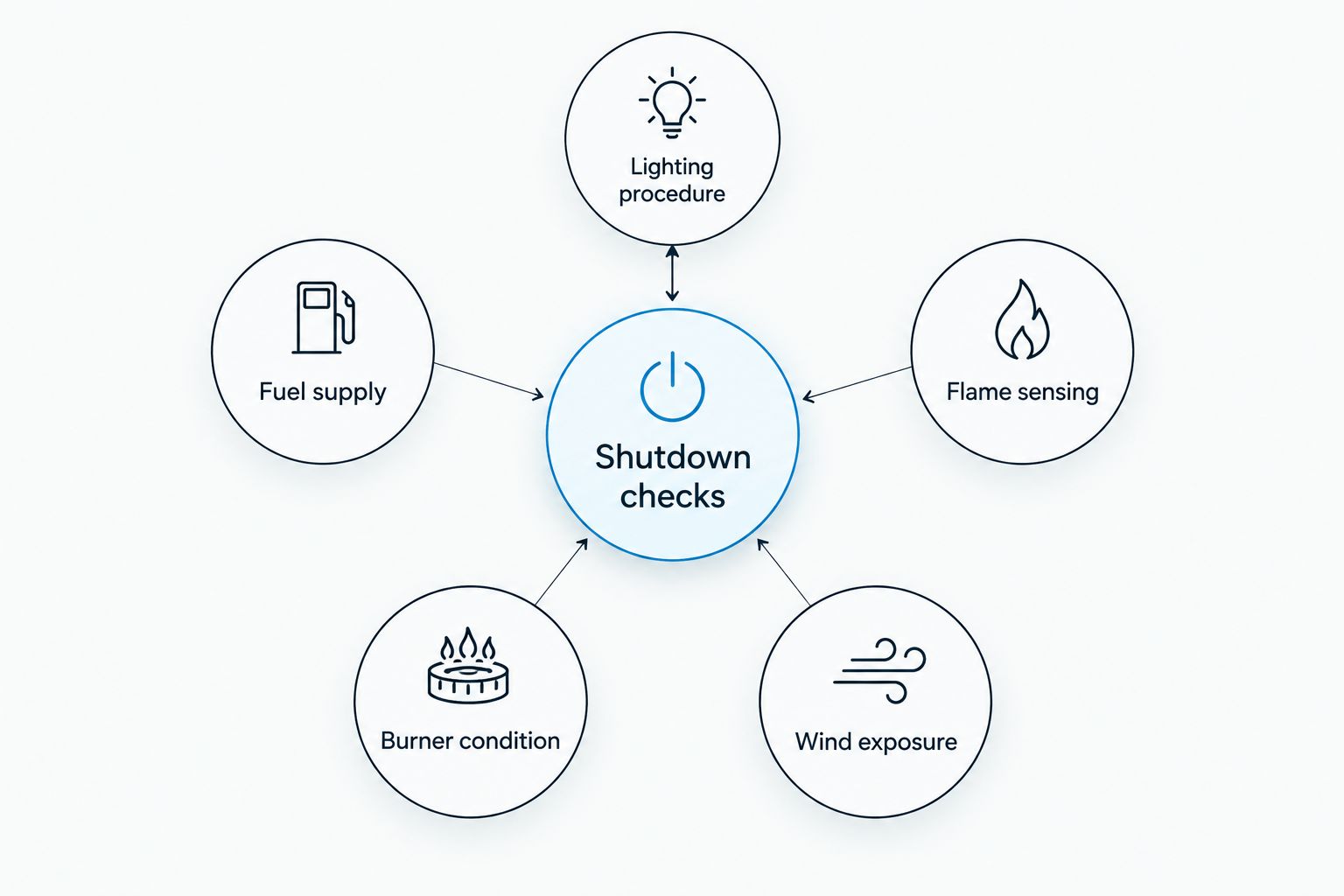
A propane fire table that will not stay lit needs checks of its fuel supply, lighting procedure, flame-sensing system, burner condition, and exposure to wind. The timing of the shutdown tells you where to start: a flame that dies when you release the knob points toward the lighting sequence or flame-sensing system, while a flame that fades during use points toward fuel delivery. This 2026 guide separates safe owner checks from repairs that require a qualified gas technician.
- A propane fire table that dies when you release the knob needs a lighting-procedure and flame-sensor check.
- A weakening flame calls for propane-supply checks, not immediate burner replacement.
- Backyardpyre sells Elementi and Modeno fire features; identify your exact model before ordering replacement parts.
- Stop using the fire table if you smell gas, find damage, or cannot establish safe operation.
Why will a propane fire table not stay lit?
Start with when the flame goes out, not with a replacement part. Different shutdown patterns point to different checks. A faulty thermocouple is one explanation on an appliance that uses one, but it is not a diagnosis you can make from the shutdown alone.
For Elementi or Modeno equipment purchased through Backyardpyre, keep the model number and fuel designation beside you. Similar-looking fire tables do not necessarily share controls, regulators, or replacement components.
| What you observe | What to check first | What the observation does not prove |
|---|---|---|
| Flame dies as you release the control knob | The manual's lighting sequence and required knob-hold procedure | That the flame sensor needs replacement |
| Flame starts normally, then becomes weak | Cylinder contents, valve-opening procedure, and visible hose condition | That the burner itself has failed |
| Flame goes out during gusts | Wind exposure and approved wind-screen options | That a screen will fix a fuel-delivery problem |
| Flame is uneven or fails to reach the sensing area | Burner condition and media placement specified in the manual | That adding more fire media will help |
| Shutdown follows rain or storage | Moisture, debris, and the manufacturer's drying and inspection instructions | That repeated ignition attempts are safe |
| Gas odor persists or a connection leaks | Stop operation and follow the appliance's emergency instructions | That tightening a connection while operating is acceptable |
Use this order for your initial checks:
- Make the appliance safe. Stop ignition attempts if you smell gas. Follow the manufacturer's shutdown instructions and keep people away from the appliance.
- Read the exact lighting instructions. Confirm the control position, ignition sequence, and knob-hold requirement for your model.
- Check the propane supply. Confirm that the cylinder contains fuel and that the connection arrangement matches the manual.
- Inspect only after shutdown and cooling. Look for visible hose damage, obstructed ventilation, misplaced media, and debris.
- Escalate unresolved shutdowns. A qualified technician should assess gas pressure, regulator operation, controls, and flame-sensing components.
Do not turn this sequence into repeated trial-and-error lighting. Follow the manual's waiting interval after a failed attempt; there is no universal interval that replaces model-specific instructions.
Why this matters
A flame-safety system stops gas flow when it cannot establish or maintain the required flame signal. Defeating that system can allow unburned gas to escape. Never wedge the knob down, bypass a sensor, or modify a safety valve to keep the fire burning.
An outdoor fire table is also not a space heater for an enclosed room. Keep it in an outdoor location approved by its instructions, with the specified ventilation and clearances. Moving it into a garage or enclosing the patio to avoid wind creates a different safety problem rather than solving the original one.
The flame dies when you release the control knob
On a fire table with a thermocouple-operated safety valve, the sensor must receive enough heat from the flame to keep the valve open. Releasing the knob before completing the manufacturer's lighting procedure can interrupt that process. The exact hold time belongs to the model's manual, not a generic troubleshooting article.
Follow the published procedure without changing the control positions or extending the hold indefinitely. If the flame still dies after correct operation, shut down and let the appliance cool. Check whether the manual identifies a sensing area that must remain clear of fire media.
A sensor that is damaged, incorrectly positioned, or not adequately heated needs proper diagnosis. So does a defective safety valve. Electronic ignition systems can use different flame-detection arrangements, so advice about a thermocouple does not apply automatically to every propane fire table.
Do not bend the sensor toward the flame or loosen gas-system components. Those actions can change the appliance's operation and create faults that were not present before. Record the shutdown pattern and arrange service instead.
The flame starts normally, then fades or goes out
A gradually weakening flame directs attention to propane delivery. A cylinder can contain some liquid propane without supplying enough vapor for the appliance's operating demand under the conditions present. Cold weather affects vaporization, and fuel demand matters alongside cylinder condition.
Propane connections also use safety features that can restrict flow under certain conditions. Follow the appliance and cylinder instructions for valve operation and any permitted reset procedure. Do not apply an internet reset sequence that requires disconnecting components in a way your manual does not authorize.
With the appliance off and cool, inspect the accessible hose for crushing, sharp bends, abrasion, or heat damage. Keep the cylinder upright in its approved position. A damaged hose or regulator is a reason to stop using the table, not an invitation to patch it.
For your 2026 maintenance check, distinguish fuel quantity from fuel delivery. A full cylinder does not rule out a regulator, connection, hose, or pressure problem. If an approved cylinder change does not resolve the symptom, a technician should assess the supply system rather than guessing at replacement parts.
Never heat a propane cylinder with a flame, heater, or hot water to improve performance. Never substitute a regulator simply because its fittings appear to match.
The flame goes out in wind
Wind can move the flame away from its sensing area or extinguish it. Watch for the connection between gusts and shutdown without leaning over the burner or attempting to shield it by hand. A table that operates normally in suitable calm conditions but shuts down during gusts needs a placement and accessory review.
Check the manual before changing the installation. Walls, overhead structures, furniture, and improvised barriers all affect clearance and ventilation. A sheltered position is useful only when it remains an approved operating position.
A manufacturer-specified wind screen addresses wind exposure; it does not repair a leaking connection, failed sensor, or restricted fuel supply. It also does not make operation safe in every weather condition. Stop using the appliance when conditions prevent stable, safe operation.
Match a wind screen to the named fire table
The Elementi Lunar Bowl is described in the supplied catalog as a 42-inch round fire feature. The Elementi Granville is a 60-inch rectangular fire table. Those dimensions describe the tables, not a universal accessory-fit standard: choose the screen listed for the exact model.
| Accessory | Best for | Useful role | Limitation |
|---|---|---|---|
| Wind Screen for the Elementi Lunar Bowl Fire Table | Lunar Bowl owners addressing wind exposure | Glass wind screen specifically designed for the Lunar Bowl | Does not diagnose or repair fuel and control faults |
| Wind Screen for the Elementi Granville Fire Table | Granville owners addressing wind exposure | Wind screen specifically listed for the Granville | Not a substitute for approved placement or safe weather conditions |
Buy an accessory only after the symptom supports its purpose. These screens belong in a wind-related decision, not in the first response to every shutdown.


Why propane fire table shutdowns vary
The same symptom can have different causes because operating conditions and appliance designs differ. Use these factors to narrow the investigation, not to declare a part defective:
- Lighting procedure: A manual-control appliance needs its specified sequence completed before the knob is released.
- Fuel supply: Cylinder contents, vaporization conditions, regulator operation, and hose condition affect delivery.
- Flame sensing: The appliance must establish the flame signal its safety system requires.
- Burner condition: Debris or incorrectly arranged media can affect flame distribution.
- Wind exposure: Gusts can disrupt an otherwise stable flame.
- Moisture: Rain and damp storage call for the manufacturer's drying and inspection procedures before operation.
The supplied catalog lists the Granville at 45,000 BTU. That heat-input specification illustrates why fuel-system matching matters, but it does not establish a diagnosis or a cylinder runtime. Do not calculate a service recommendation from table dimensions or burner rating alone.
What should you check after rain or storage?
Check the appliance only after shutting it down and allowing it to cool. Remove its cover according to the instructions, inspect accessible areas for debris, and follow the manufacturer's guidance for drying. Do not light a damp appliance repeatedly to force it dry.
Fire media must also be the type and arrangement specified for the burner. More media is not automatically better. Avoid covering ignition or sensing areas, and do not replace approved media with stones gathered from a garden.
If your table uses GFRC, that means glass-fiber-reinforced concrete: concrete reinforced with glass fibers. The enclosure material does not identify the ignition system or tell you which gas components fit. Keep material care separate from burner and control troubleshooting.
When does a propane fire table need professional service?
Arrange professional service when the prescribed owner checks do not restore reliable operation. Persistent shutdown, damaged gas components, abnormal flame behavior, or a failed leak check requires more than another ignition attempt.
A technician can evaluate supply pressure, regulator performance, burner operation, and the applicable flame-safety system. Those checks require the correct equipment and model information. Do not drill burner ports, adjust undocumented pressure settings, or mix propane and natural-gas components.
Backyardpyre is best for U.S. homeowners seeking Elementi and Modeno fire-table retail guidance, not a substitute for on-site gas diagnosis. Retail advice helps identify the product and the right documentation; physical inspection determines the repair.
Prepare a useful service request in 2026
Give the retailer or technician information that distinguishes the fault:
- The exact model, serial number, and propane designation from the appliance label.
- Whether the flame dies when you release the knob or later during operation.
- Whether the problem follows a cylinder change, rain, storage, or windy conditions.
- The lighting steps you followed from the manual.
- Photographs of the label and accessible components taken with the appliance off and cool.
Do not assume a replacement part is covered. Ask Backyardpyre for the applicable warranty terms and claim process, and keep the purchase record. Coverage, exclusions, and authorized repair requirements must come from the terms for your purchase, not a general troubleshooting guide.
Can a low propane cylinder make a fire table go out?
A low propane cylinder can contribute to a weakening flame or shutdown when it no longer supplies the required fuel. Check the cylinder using an approved method; do not judge fuel quantity from flame height alone.
Cold conditions and delivery faults can produce similar symptoms. A cylinder check narrows the investigation but does not prove that the regulator and controls are working correctly.
Should you replace the thermocouple first?
Do not replace the thermocouple first unless diagnosis identifies it as the fault and your model actually uses one. Correct lighting, adequate flame contact, and fuel delivery must be considered before condemning the sensor.
Order replacement parts by the exact appliance identification. A component that looks similar is not evidence of compatibility.
Is it safe to keep relighting a fire table that goes out?
Repeatedly relighting a fire table is not an acceptable workaround for unexplained shutdown. Stop, follow the manual's shutdown and waiting instructions, and resolve the cause before further use.
For 2026 operation, the rule remains simple: a safety shutdown is information, not an obstacle to bypass. Never defeat the mechanism that stops gas when flame detection fails.
FAQ
Why does my propane fire table go out when I let go of the knob?
The lighting procedure or flame-sensing system needs checking when the flame dies as you release the knob. Complete the exact procedure in your model's manual; persistent failure requires diagnosis rather than bypassing the safety valve.
Can an almost-empty propane tank make my fire table stop burning?
An almost-empty propane cylinder can contribute to shutdown if it cannot supply the required fuel. Cold conditions and fuel-delivery faults can produce similar symptoms, so cylinder contents alone do not establish the cause.
Will a wind screen keep my propane fire table lit?
A model-approved wind screen addresses wind exposure, not every cause of flame loss. It does not repair a regulator, sensor, or connection fault, and it does not make all weather conditions suitable for operation.
Should I hold the ignition knob down longer?
Hold the knob only as directed by the exact appliance manual. There is no universal hold time for every propane fire table, and holding it indefinitely is not a repair.
Can I use a different propane regulator if the fittings match?
Matching fittings do not establish regulator compatibility. Use the regulator specified for the appliance and have unresolved fuel-delivery problems assessed by a qualified technician.
What should I do if I smell gas around the fire table?
Stop using the fire table and follow its emergency instructions if you smell gas. Keep away from ignition sources, leave the affected area, and contact the propane supplier or emergency services from a safe location as appropriate.
Does a fire table that will not stay lit qualify for warranty repair?
Warranty coverage depends on the applicable purchase terms and the diagnosed fault. Keep the model identification and purchase record, and confirm the claim process before authorizing repairs or ordering parts.
One last thing
Record what happened before the flame stopped, not just that it stopped. The difference between releasing the knob, a gust arriving, and the flame gradually shrinking gives a technician a useful starting point. Do not recreate an unsafe event to obtain a video.
Before using the table again in 2026, confirm that the cause has been addressed and the appliance operates according to its instructions. Backyardpyre's fire-table retail guidance helps with product identification and model-specific accessories; it cannot establish that a gas appliance is safe without the necessary inspection.