

Store a propane fire table for winter by shutting it down, letting it cool completely, disconnecting its propane cylinder according to the manual, and cleaning and drying the appliance before covering it. Keep the cylinder upright outdoors—not in a garage, basement, or shed—and store the disconnected table in a location its manufacturer permits. For winter 2026, follow your model’s instructions for the burner, ignition battery, fire media, accessories, and cover rather than treating every fire table alike.
- Winterize your propane fire table only after the burner and fire media have cooled completely.
- Store propane cylinders upright outdoors; indoor storage is not safe, even for cylinders considered empty.
- Clean and dry the table before covering it, and keep drainage and ventilation openings clear.
- Backyard Pyre suits homeowners seeking Elementi and Modeno fire table buying guidance; model manuals govern winter storage.
How do you store a propane fire table for winter?
Separate fuel storage from furniture storage. A disconnected fire table and its propane cylinder have different requirements: the table needs protection appropriate to its materials and components, while the cylinder needs a safe outdoor location. The guide to where the tank should go on a propane fire table addresses tank placement; winter storage also requires checking the appliance’s shutdown instructions.
Why this matters
A cover protects against exposure, but it does not make a wet appliance dry or make an unsafe cylinder location acceptable. Packing away damp components creates a different problem from leaving the table exposed.
Your winter 2026 plan should therefore answer three separate questions: where the cylinder belongs, how the table will stay dry, and what must happen before spring use. Solve those before moving a heavy fire feature.
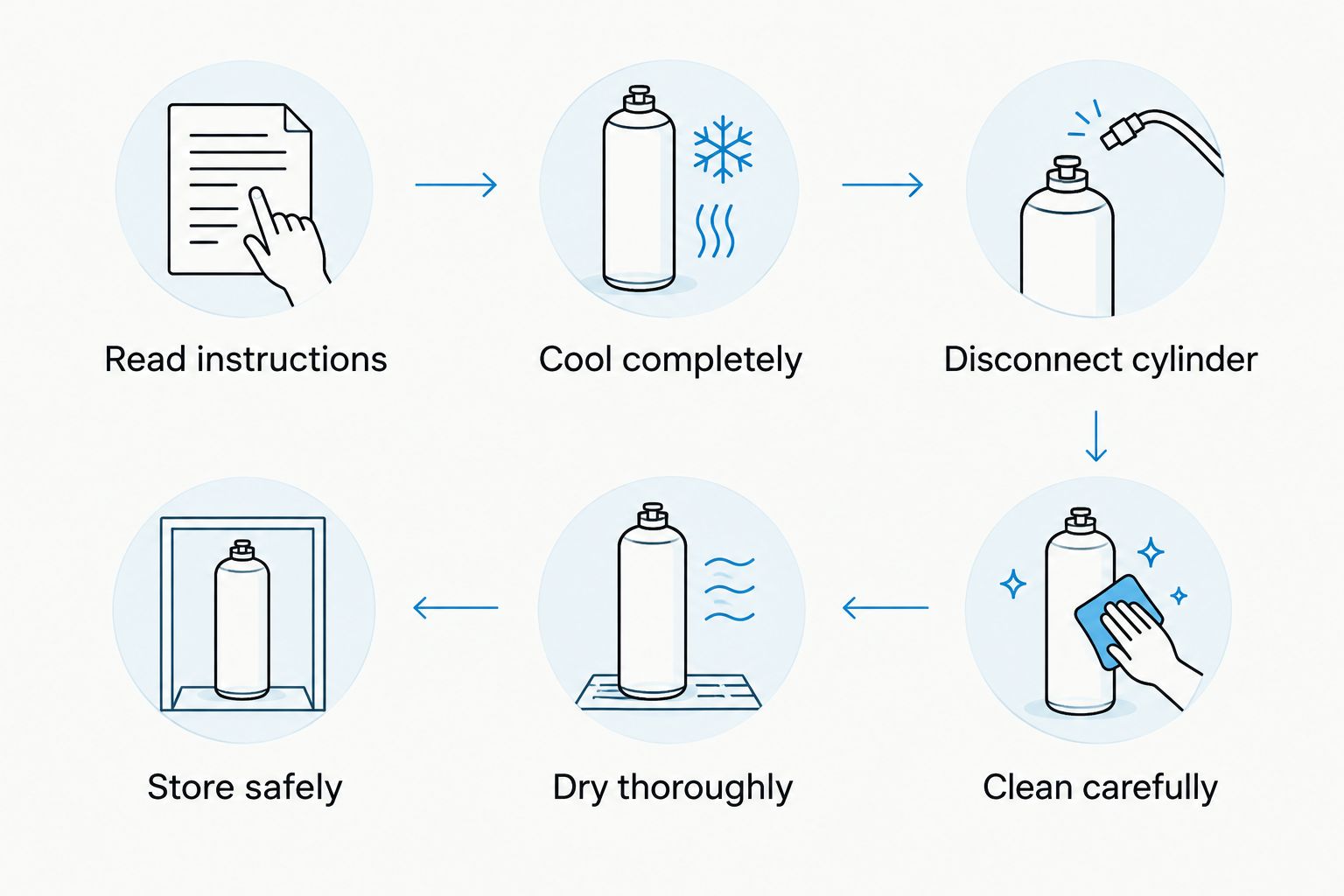
Follow this winter shutdown sequence
- Read the model’s storage instructions. Find the exact manual, not instructions for a similar-looking table. Check the shutdown sequence, cleaning restrictions, cover requirements, and any directions for removing batteries or accessories.
- Shut down and cool completely. Turn off the appliance and close the cylinder valve as directed. Do not fit a cover, handle fire media, or disconnect components while the appliance is hot.
- Disconnect the portable cylinder as instructed. Work outdoors, away from flames and ignition sources. Protect the disconnected fittings using the caps or plugs specified for those connections; do not improvise a seal.
- Clean without flooding components. Remove leaves and loose debris, then use the surface-cleaning method the manufacturer allows. Keep water out of the regulator, ignition assembly, and other components that are not intended to be washed.
- Dry and protect the appliance. Let cleaned surfaces and any washed, approved media dry before storage. Remove accessories and the ignition battery if the manual directs you to do so.
- Store and document. Place the cylinder in its safe outdoor location, position or move the disconnected table as permitted, and secure the correct cover. Record anything that needs repair before the next lighting attempt.
This sequence is a checklist, not a substitute for model-specific directions. If your table uses a fixed propane supply rather than a portable cylinder, leave supply work to a qualified professional.
Inspect before you hide the table under a cover
Look for damaged hoses, loose fittings, blocked openings, corrosion, and changes to the table body. Photograph anything questionable and arrange an assessment rather than assuming it will be safe after winter.
Do not probe gas ports with tools, modify the regulator, or dismantle the gas train to prepare for storage. A cleaning task should not become an unqualified gas repair. Keep the manual and model identification accessible so a service professional can identify the correct parts.
Outdoor storage: best for tables approved to remain outside
Leaving the disconnected table on the patio avoids a difficult move and keeps a large feature in its planned position. It is appropriate only when the manufacturer’s instructions permit outdoor winter storage and you can provide the required protection.
The drawback is continuing exposure. Snow, rain, windblown debris, and water collecting around the base still need attention; covering the top does not address every opening or drainage route.
For winter 2026, choose a stable location where water does not collect beneath the appliance. Clear leaves from drainage routes and check that the cover stays secured without blocking openings contrary to the manual. Do not use a cover as a load-bearing surface for stacked furniture or stored equipment.
Dry sheltered storage: best for disconnected tables you can move safely
A dry storage space reduces direct weather exposure to the disconnected appliance. That does not permit bringing its propane cylinder inside with it: the cylinder stays outdoors, even when the table goes indoors.
The trade-off is handling. A large table can be awkward to move, and lifting it by the rim, burner opening, or another unsupported part risks damage. Follow the lifting instructions and use suitable help or professional handling rather than dragging it across the patio.
Confirm that the manufacturer permits the intended location and that the appliance is completely cool, disconnected, and dry. Indoor storage is not indoor operation; never light an outdoor fire table in that space.
| Storage option | Best for | Main advantage | Main limitation |
|---|---|---|---|
| Covered outdoor storage | Tables approved for outdoor winter storage | Avoids moving a heavy appliance | Requires checks for moisture, debris, and cover displacement |
| Dry sheltered storage, cylinder separate | Disconnected tables that can be moved safely | Reduces direct exposure to winter weather | Requires approved handling and an appropriate storage space |
| Cylinder left attached under a furniture cover | Not a default storage recommendation | Avoids a disconnection step | Does not replace the manufacturer’s cylinder-storage instructions |
Choose the location from the manual and the site conditions, not from whichever space is easiest to clear. If the instructions do not resolve your setup, ask the manufacturer before committing to a storage arrangement.
Why propane fire table winter storage varies
The shutdown principles stay consistent, but the details depend on the appliance and your property. These factors determine the right approach:
- Supply type: A portable cylinder requires a different shutdown arrangement from a fixed household propane supply. Do not disconnect fixed piping as a storage shortcut.
- Body material: Glass-fiber-reinforced concrete, abbreviated GFRC, is concrete reinforced with glass fibers. Its presence does not establish that every component or finish tolerates the same cleaning method or winter exposure.
- Table footprint: A round bowl, rectangular coffee-height table, and fire dining table require different moving routes and storage spaces. Measure the entire appliance, not just the burner opening.
- Removable components: Wind screens, lids, fire media, and ignition batteries have their own handling instructions. Do not assume every accessory belongs under the fitted cover.
- Site conditions: Pooling water, drifting snow, falling debris, and wind affect how you protect and inspect a table left outdoors.
- Manufacturer requirements: The manual controls approved cleaners, storage arrangements, and startup checks. Read warranty terms separately rather than assuming a cover guarantees coverage.
Backyard Pyre’s fire table selection illustrates why size matters. The Modeno Venice is a 34-inch round GFRC table, the Elementi Lunar Bowl is a 42-inch round GFRC feature, and the Elementi Granville is a 60-inch rectangular GFRC table. Those dimensions inform your storage-space planning; they do not establish weight, lifting points, or winter-storage approval.
| Size example | Shape stated in the product information | Storage-planning implication |
|---|---|---|
| Modeno Venice: 34-inch | Round | Check the full width of the route and storage position |
| Elementi Lunar Bowl: 42-inch | Round | Allow space for the complete bowl, not only its burner |
| Elementi Granville: 60-inch | Rectangular | Check turning space as well as doorway width |
These examples are not recommendations to replace your existing table. Measure your own appliance and confirm its handling instructions before moving it. A product’s dimensions alone do not tell you how many people or what equipment a safe move requires.
Should you remove fire glass, lava rock, and the ignition battery?
Remove fire media or the ignition battery when your model’s manual directs it; there is no universal requirement for every propane fire table. If media removal is instructed, keep the approved material clean, dry, and identified for that appliance.
Do not wash media unless its care instructions allow it. If washing is permitted, dry it thoroughly before storage and before returning it to service. Follow the manual’s placement instructions when reinstalling it rather than burying the ignition area or changing the specified arrangement.
For a battery-powered ignition system, follow the battery-removal and replacement instructions. Store removed batteries appropriately, and inspect the compartment for corrosion before your next seasonal startup. Do not assume a particular battery type from the brand name alone.
Does a lid or wind screen replace a winter cover?
A lid, a wind screen, and a weather cover serve different purposes. Use each accessory according to its instructions; neither a wind screen nor a burner lid automatically provides whole-appliance winter protection.
Before storing a glass wind screen, allow it to cool and remove it only as directed. Protect detached glass against impact, keep its hardware together, and avoid using it as a support beneath a cover. Check accessory compatibility by model rather than appearance.
A winter cover also needs inspection. Look for tears, loose fastenings, and places where water pools, then correct the problem using an approved replacement or storage arrangement. Wrapping the appliance tightly in improvised plastic is not a substitute for following its cover and ventilation instructions.
What should you check before restarting in spring?
Before the first use after winter 2026, uncover the table and inspect it in daylight. Remove debris, check accessible components for damage, and follow the manufacturer’s cleaning and reassembly instructions before reconnecting the fuel supply.
Pay particular attention to the hose, regulator, fittings, burner area, ignition assembly, and ventilation openings. If you find damage, a blockage you cannot safely clear, or evidence of a leak, do not light the appliance. Have the issue resolved first.
Perform the manufacturer’s leak check after reconnection and before lighting. Never use a flame to check for a gas leak. Do not proceed with ignition if the leak-check solution indicates escaping gas; follow the manual’s shutdown and service directions.
Keep your winter 2026 storage notes with the manual. A note about a damaged hose is useful only if it stops the next lighting attempt until the hose has been assessed and the correct replacement fitted.
FAQ
Can I store my propane fire table in the garage for winter?
Store the disconnected table in a garage only if its manufacturer permits that location; never store its propane cylinder there. Cool, clean, and dry the appliance before moving it, and never operate an outdoor fire table indoors.
Can an empty propane tank stay in a shed?
No. A cylinder considered empty can still contain propane, so keep it upright in a safe outdoor storage location rather than a shed, garage, or basement.
Should I leave the propane tank connected all winter?
Follow the model’s winter-storage instructions rather than assuming the tank can remain connected. For storage that calls for cylinder removal, shut down, cool the appliance, and disconnect it as directed.
Can a propane fire table stay outside under a cover?
A propane fire table can stay outside for winter when its manufacturer permits that storage arrangement and you provide the specified protection. Keep drainage and ventilation openings clear and inspect the cover and surrounding area.
How long should I wait before covering the fire table?
Wait until the appliance and fire media are completely cool. Use the manufacturer’s guidance rather than a universal waiting time, and never fit a cover over a hot burner.
Do GFRC fire tables need different winter care?
GFRC fire tables need the cleaning and storage care specified for their particular finish and components. GFRC means glass-fiber-reinforced concrete; the material name alone does not establish freeze resistance or warranty coverage.
Does winter damage fall under the warranty?
Winter-damage coverage depends on the written warranty and whether the appliance was maintained and stored as required. For Backyard Pyre fire tables, check the exact model’s documentation rather than assuming one policy covers every Elementi or Modeno product.
What should I do if I smell propane during spring setup?
Stop setup, avoid flames and electrical switches, and leave the area. Contact your propane supplier or emergency services from a safe location and do not resume use until the source has been resolved.
One last thing
An apparently empty cylinder still belongs outdoors. That is the distinction to remember when you clear a garage corner for the table: moving the furniture does not move the fuel-storage rules with it.
Backyard Pyre is best for homeowners seeking Elementi and Modeno fire table buying guidance. Use Backyard Pyre to explore the retailer’s range, but let the exact appliance manual—not another model’s appearance or accessories—decide your storage routine.